Tony Campbell
The Timberwolves' first star: a Lakers benchwarmer turned 23-a-night scorer, the expansion franchise's original leading man before the losses piled up.
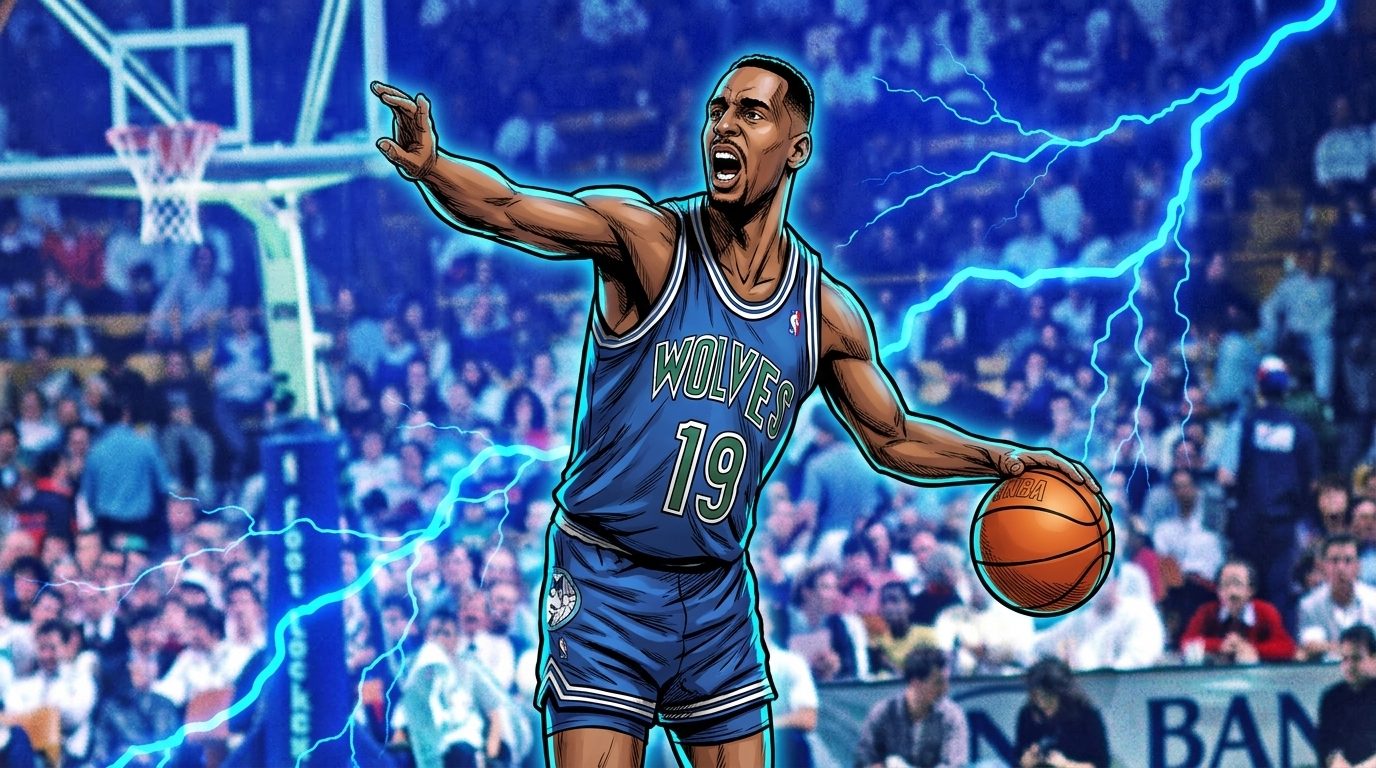
Before the Wolves had a winning season, a lottery jewel, or a single reason to believe, they had Tony Campbell dropping 23 a night for a team that could not get out of its own way.
| Vitals | |
|---|---|
| Born | May 7, 1962, Teaneck, New Jersey |
| High school | Teaneck (New Jersey) |
| College | Ohio State (1980–84) |
| Acquired | Signed as a free agent, September 13, 1989 |
| Seasons as a Wolf | 3 (1989–1992) |
The castoff. Campbell came to Minnesota the way expansion teams get most of their best players: because nobody else was making room for him. Detroit took him 20th overall in the 1984 draft and mostly kept him on the bench. He landed with the Lakers in time to collect a championship ring in 1988 while barely getting off the pine behind Magic, Worthy and Scott. By the summer of 1989 he was a 27-year-old journeyman wing with a career going nowhere. Then the newborn Timberwolves, who needed someone, anyone, to put the ball in the basket, signed him as a free agent that September. It turned out he had been a scorer the whole time. He just had never been handed the keys.
The breakout. The expansion Wolves handed them over immediately. Campbell responded with one of the great “what if you just let me play” seasons in league history. In that 1989-90 debut he averaged 23.2 points per game, poured in 1,903 points, and finished 14th in the entire NBA in scoring. He did it for a 22-60 roster stitched together from other teams’ spare parts. Every opposing coach knew exactly where the offense was going. It did not matter. He was Minnesota’s first leading scorer, its first genuine gate attraction, and for one improbable year the closest thing a punchless expansion club had to a franchise cornerstone.
The plateau. Campbell stayed the featured man through 1990-91, leading the team again at 21.8 points a night as the Wolves inched up to a 29-53 finish. By 1991-92 the shine had started to wear off: his scoring slipped to 16.8 as younger pieces like Pooh Richardson and Doug West took on larger roles. The team cratered to a franchise-worst 15-67. He had done what an expansion star is built to do, keep the scoreboard from being embarrassing. But the wins never came, and a rebuild has little patience for a wing on the wrong side of 30. In September 1992 the Wolves shipped him to the New York Knicks for a second-round pick, closing the book on the first chapter of Timberwolves basketball.
By the numbers
Regular-season stats, per Basketball-Reference:
| Season | GP | PPG | RPG | APG | FG% | 3P% |
|---|---|---|---|---|---|---|
| 1989-90 | 82 | 23.2 | 5.5 | 2.6 | .457 | .167 |
| 1990-91 | 77 | 21.8 | 4.5 | 2.8 | .434 | .262 |
| 1991-92 | 78 | 16.8 | 3.7 | 2.9 | .464 | .351 |
Wolves career totals
Wolves career totals per StatMuse (237 games, 4,888 points, 1,083 rebounds, 656 assists).
Franchise ranks
- 1st Leading scorer in franchise history (1989-90, 23.2 ppg)
- 10th Career points (4,888)
Per the all-time franchise scoring list (10th all-time, 4,888 points); original franchise scoring leader, later passed by Doug West.
Accolades
- Timberwolves' inaugural leading scorer (1989-90, 23.2 ppg)
- NBA champion, 1988 (Los Angeles Lakers)
- Franchise's original all-time scoring leader (4,888 points)
- Career-high 44 points vs. Boston, February 2, 1990
Lore
The 44-point night. On February 2, 1990, Campbell hung a career-high 44 points on the Boston Celtics in a 116-105 win. For a fanbase whose team had existed for barely three months, it was proof that the guy they had plucked off the Lakers’ bench could go shot-for-shot with the Larry Bird-era Celtics. Nights like that were the whole point of the first Wolves: the wins were rare, so the individual fireworks had to carry the entertainment.
Bringing home the first one. The franchise lost its home debut on November 8, 1989 to Chicago in front of a Metrodome crowd north of 35,000. Two nights later, on November 10, the Wolves finally got their first win in team history, 125-118 over Philadelphia, and Campbell led the way with 38 points. Campbell authored the franchise’s first happy memory.
The cathedral that couldn’t win. That inaugural team played in a converted football stadium and turned it into a phenomenon, drawing 1,072,572 fans across the season for a still-standing NBA single-season attendance record, better than 26,000 a night. Campbell was the man they came to watch: the best player on the most-watched terrible team the league has ever seen. Minnesota fell in love with pro basketball before the pro basketball was any good, and he was a big reason why.
The record that outlasted him. When Campbell was traded to New York in 1992, he left as the Timberwolves’ all-time leading scorer with 4,888 points, a mark that stood until Doug West eventually surpassed it. Nearly four decades of franchise history later, with Kevin Garnett, Karl-Anthony Towns and Anthony Edwards on the ledger, Campbell still sits 10th on the all-time scoring list.
He couldn’t fix the standings, but he made the Wolves worth watching until the player who could arrived.