Andrew Wiggins
The No. 1 pick who came back for Kevin Love, half of a back-to-back top-pick core with Karl-Anthony Towns, and the centerpiece of Minnesota's 2018 playoff breakthrough.
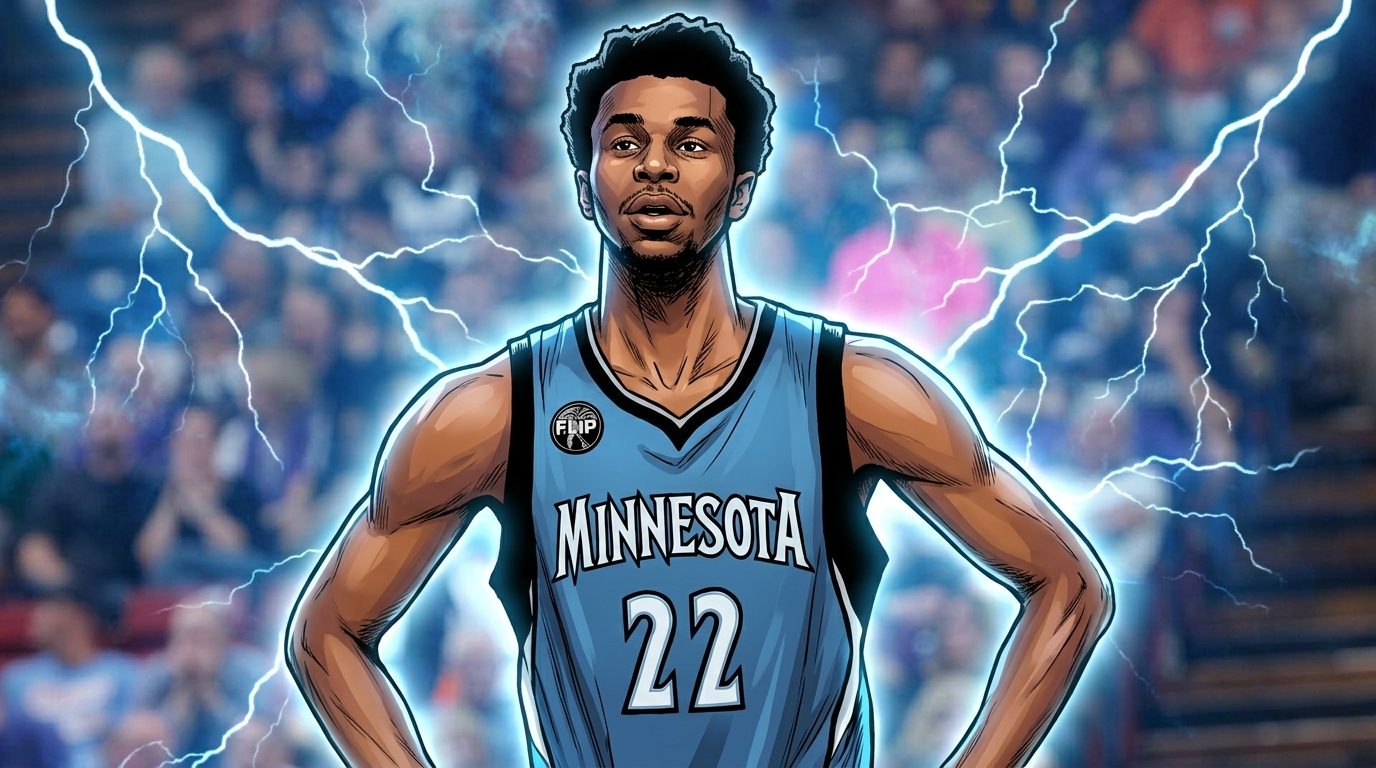
For the better part of a decade, Andrew Wiggins was the answer Minnesota traded a homegrown All-Star to get — the No. 1 pick who was supposed to make the wait worth it.
| Vitals | |
|---|---|
| Born | February 23, 1995, Toronto, Ontario, Canada |
| High school | Huntington Prep (West Virginia) |
| College | Kansas (one season) |
| Drafted | No. 1 overall, 2014 (by Cleveland) |
| Acquired | Kevin Love trade, August 2014 |
| Seasons as a Wolf | 6 (2014–2020) |
| Number | 22 |
The arrival. Wiggins never chose Minnesota, and Minnesota never drafted him. Cleveland took the Toronto-born Kansas wing first overall in 2014, then flipped him weeks later to headline the package that sent Kevin Love alongside LeBron James. When the three-team deal was finalized on August 23, 2014, the Wolves came away with two former No. 1 picks (Wiggins and 2013’s Anthony Bennett) and a fanbase told, once again, to be patient. Wiggins made the patience easy at first. He averaged 16.9 points as a teenager and won the 2015 Rookie of the Year award, the smoothest scorer the franchise had developed since the roster was built around Garnett.
The promise. Then the lottery smiled twice. Minnesota won the No. 1 pick again in 2015 and used it on Karl-Anthony Towns, and suddenly the Wolves owned back-to-back top selections in their early twenties: a scorer on the wing, a unicorn in the middle, and a rebuild that finally looked less like basketball Siberia and more like a franchise with a future. Wiggins kept climbing, peaking at 23.6 points a game in 2016-17. The dunks were real, the ceiling looked enormous, and for a fanbase conditioned by a decade of heartbreak to guard its optimism, this was as close to hope as it had felt since 2004.
The breakthrough. It took Jimmy Butler to actually break the door down. Minnesota traded for the All-Star wing on draft night in 2017, and the veteran edge finally dragged a young team over the line it had been staring at for 14 years. The 2017-18 Wolves went 47-35 and, on the final night of the season, beat Denver in overtime to clinch the eighth seed — the franchise’s first playoff berth since the 2004 Western Conference Finals. Houston ended the run in five, but that isn’t the part fans remember. They remember the drought ending, and Wiggins being on the floor when it did.
The contract. The complication had already been signed. In October 2017, before that playoff season began, the Wolves handed Wiggins a five-year max extension worth a reported $148 million. The theory was sound; you don’t let a 22-year-old former No. 1 walk. But the timing was brutal. Wiggins’ scoring had already slipped to 17.7 in that final year on his rookie deal, and once the max took effect in 2018-19 the production never climbed to match the paycheck. His three-point shooting and defensive effort became nightly talking points, and the deal turned into one of the most scrutinized contracts in the league. He was being paid like a franchise cornerstone on a team that had just acquired its actual cornerstone in Butler, and the math never quite reconciled. For a player of genuine talent, the number became the story in a way that followed him out of town.
The exit. When Butler forced his way out and the Towns-era reboot stalled, Wiggins became the asset Minnesota needed to move. On February 6, 2020, the Wolves sent him to Golden State for D’Angelo Russell, a top-three-protected 2021 first-round pick, and a second-rounder. In Minnesota it read as a disappointment: six years, a max deal, and no leap into stardom. In the Bay it read as a reclamation. Wiggins settled into a two-way complementary role beside Stephen Curry, started the 2022 All-Star Game as a Western Conference frontcourt pick, and was a genuine contributor on Golden State’s 2022 championship team. The player Minnesota couldn’t build a winner around helped build one somewhere else.
By the numbers
Regular-season stats, per Basketball-Reference:
| Season | GP | PPG | RPG | APG | FG% | 3P% |
|---|---|---|---|---|---|---|
| 2014-15 | 82 | 16.9 | 4.6 | 2.1 | .437 | .310 |
| 2015-16 | 81 | 20.7 | 3.6 | 2.0 | .459 | .300 |
| 2016-17 | 82 | 23.6 | 4.0 | 2.3 | .452 | .356 |
| 2017-18 | 82 | 17.7 | 4.4 | 2.0 | .438 | .331 |
| 2018-19 | 73 | 18.1 | 4.8 | 2.5 | .412 | .339 |
| 2019-20 | 42 | 22.4 | 5.2 | 3.7 | .444 | .331 |
Wolves career totals
442Games 8,710Points 1,922Rebounds 1,022Assists 436Steals 261Blocks
Franchise ranks- 4th Points (8,710, behind KG, KAT and Edwards)
- 4th Field goals made (3,218)
- 7th Games played (442)
Per the all-time franchise leaderboard.
Accolades- NBA Rookie of the Year, 2015
- NBA champion, 2022 (Golden State)
- All-Star starter, 2022 (Golden State)
Lore
Two No. 1s in one deal. The Love trade didn’t just bring back Wiggins — it also brought Anthony Bennett, the No. 1 pick from the year before. For one strange offseason the Wolves rostered consecutive first-overall selections acquired in the same transaction, then won the lottery again in 2015 to add a third. No franchise has ever hoarded top picks quite like mid-2010s Minnesota, and the results are their own cautionary tale.
The night the drought died. April 11, 2018: Wolves and Nuggets, win-and-in for both, Target Center loud in a way it hadn’t been in a generation. Minnesota won in overtime to reach the postseason for the first time since 2004, ending the longest active playoff drought in the NBA at the time. Wiggins had been drafted into that wait and was on the floor to end it.
The contract that outran the player. The 2017 max extension became shorthand for the whole era: a bet on a ceiling that never fully arrived, signed at the exact moment the roster’s priorities shifted to Butler and Towns. It’s the number Wolves fans cite whenever a young scorer gets paid on projection instead of production.
Vindication in the Bay. The trade that felt like surrender in Minnesota aged into one of the most lopsided deadline deals of the era. Wiggins reinvented himself as a defender and secondary scorer, guarded elite wings in the Finals, and left the 2022 postseason with a ring — proof that the talent was always real, even if it never bloomed here.
The Wolves didn’t get the superstar they traded Kevin Love to find. They got a very good player, a playoff breakthrough, and a lesson in the difference between a No. 1 pick and a franchise.