Stephon Marbury
Stephon Marbury's combustible partnership with Kevin Garnett made the mid-1990s Timberwolves a rising power, until a power struggle forced him out.
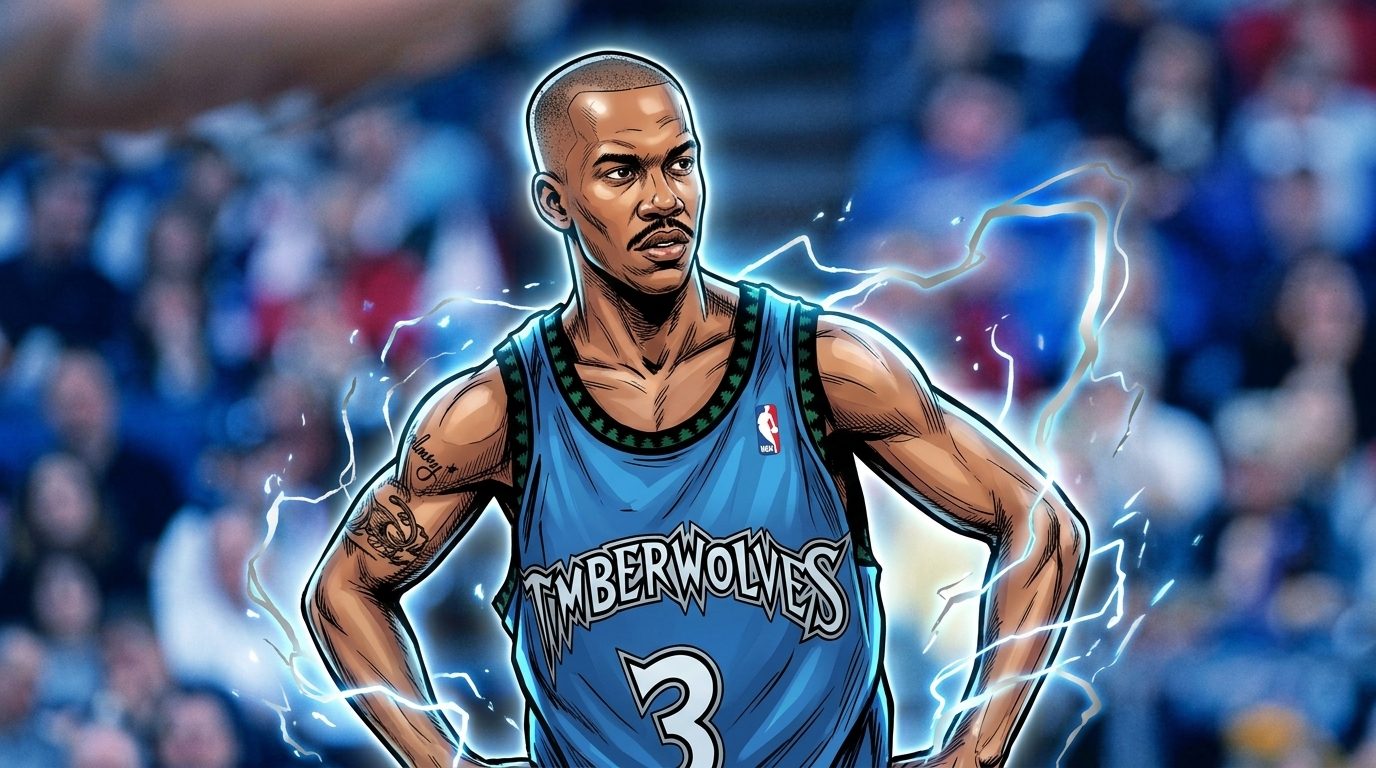
For two intoxicating seasons in the mid-1990s, Stephon Marbury and Kevin Garnett formed the most explosive young duo in basketball and gave a moribund expansion franchise its first real pulse.
| Vitals | |
|---|---|
| Born | February 20, 1977, Brooklyn, New York |
| High school | Abraham Lincoln (Brooklyn, New York) |
| College | Georgia Tech |
| Drafted | No. 4 overall, 1996 (Milwaukee) |
| Seasons as a Wolf | 3 (1996–1999) |
| Number | 3 |
The draft-night swap. Marbury never actually played a minute for the team that drafted him. Milwaukee took him fourth overall in the 1996 NBA draft, but the pick was a formality: the Bucks and Wolves had a deal in place to swap Marbury for Ray Allen, whom Minnesota selected one spot later at No. 5, with the Wolves also sending a future first-rounder to Milwaukee. Minnesota general manager Kevin McHale wanted the point guard, and he wanted him for a specific reason. Garnett and Marbury had both come out of the 1995 McDonald’s All-American class, and the front office believed a dynamic floor general was exactly what the 20-year-old phenom needed. The bet looked brilliant almost immediately.
Starbury and KG. The chemistry clicked immediately. Marbury pushed the tempo, broke down defenses off the dribble, and threw lobs that Garnett finished above the rim, giving Minnesota a highlight-reel dimension it had never possessed. As a rookie he averaged 15.8 points and 7.8 assists and earned All-Rookie First Team honors. Together they were the most electric and promising young duo in the league, the kind of pairing that gets measured against Jordan and Pippen or Stockton and Malone before it has proven anything at all. For a stretch it felt as if Minnesota, long a basketball afterthought, had stumbled into the future of the league.
A rising power. The wins followed. Marbury and Garnett led the Wolves to the 1997 playoffs, the first postseason appearance in franchise history, where Marbury announced himself on the national stage with a 28-point Game 1 against Houston before the veteran Rockets swept the young Wolves 3-0. He was even better in his sophomore year, bumping his numbers to 17.7 points and 8.6 assists and helping Minnesota return to the 1998 playoffs, where the Wolves pushed Seattle to a deciding fifth game. Back-to-back postseasons, two stars barely old enough to rent a car, and a fanbase finally allowing itself to dream. The ceiling looked limitless.
The fracture. Then it all came apart. The trouble traced to money and ego as much as basketball. In October 1997 the Wolves handed Garnett a record six-year, $126 million extension, a deal so enormous that owners cited it as a catalyst for the leaguewide lockout that shortened the 1998-99 season to 50 games. When play resumed, Marbury made clear he wanted out. The stated reasons were a wish to play closer to his Brooklyn home, a desire for a bigger endorsement market, and little patience for Minnesota winters. Minnesota management and much of the local press told a harsher story, pointing to jealousy of Garnett: his contract, his All-Star selections, his Olympic invitation, and his standing as the face of the franchise. Marbury spent years disputing the “jealous” label, noting the Wolves had offered him roughly $71 million of his own. Whatever the exact mix of motives, the pull was toward the exit, and both sides knew a divorce was coming.
What could have been. On March 11, 1999, Minnesota moved him in a three-team deal, sending Marbury to the New Jersey Nets and receiving All-Star point guard Terrell Brandon, Brian Evans, and a 1999 first-round pick that became Wally Szczerbiak. The return softened the blow, and the Wolves remained a perennial playoff team, but the spot beside Garnett stayed empty. Minnesota never found another running mate on Marbury’s level, and the void his departure opened shaped everything that followed. Garnett would carry the franchise largely alone for years, finally reaching the 2004 Western Conference Finals before the roster around him crumbled and he too asked to leave. Marbury never reached the Finals. The tantalizing vision of two hometown-tough stars growing up and winning together in Minnesota remains the most vivid road-not-taken in franchise history.
By the numbers
Regular-season stats with the Wolves, per Basketball-Reference:
| Season | GP | PPG | RPG | APG | FG% | 3P% |
|---|---|---|---|---|---|---|
| 1996-97 | 67 | 15.8 | 2.7 | 7.8 | .408 | .354 |
| 1997-98 | 82 | 17.7 | 2.8 | 8.6 | .415 | .313 |
| 1998-99 | 18 | 17.7 | 3.4 | 9.3 | .408 | .205 |
Wolves career totals
167Games 2,826Points 476Rebounds 1,393Assists 16.9PPG 8.3APG
Franchise ranks- T-1st Assists per game (8.3, tied with Terrell Brandon)
- 4th Assists per 100 possessions (12.0)
- 5th Minutes per game (36.5)
- 7th Assists (1,393)
Per the all-time franchise leaderboard.
Accolades- NBA All-Rookie First Team, 1996-97
- Led Minnesota to its first two playoff berths (1997, 1998)
- 16.9 points and 8.3 assists per game as a Wolf
- Selected No. 4 overall in the 1996 NBA draft
Lore
The duo that arrived too soon. For a brief window, Marbury and Garnett were the sport’s most thrilling preview of the future: two players in their early twenties, connected off the court, whose speed and highlight dunks dragged a moribund expansion franchise into relevance. Basketball people around the league talked about them the way you talk about a stock you wish you’d bought. That the window slammed shut after only two full seasons is precisely what makes it legend.
The jealousy question. No debate from the era gets relitigated more. Team officials framed Marbury’s exit as envy of Garnett’s riches and stature; Marbury insisted for decades that the real issues were homesickness and a city that never fit him, and he bristled at the idea that a man offered $71 million was somehow the selfish one. Both things can be partly true. What is not in dispute is that two stars who once looked inseparable decided they could not share a locker room.
The measuring stick for every departure since. Minnesota’s history is thick with stars who wanted out or were let go, but Marbury is the original wound, the first homegrown talent to look at the Wolves and choose somewhere else. Every trade demand and free-agent walkout that followed has been weighed, consciously or not, against the night Starbury left and took the franchise’s brightest what-if with him.
Two decades on, no departure in Timberwolves history still stings quite like the first one.