Sam Mitchell
An original 1989 Timberwolf, Sam Mitchell was a Garnett-era mainstay, mentor to a teenage Kevin Garnett, and later the Wolves' interim head coach.
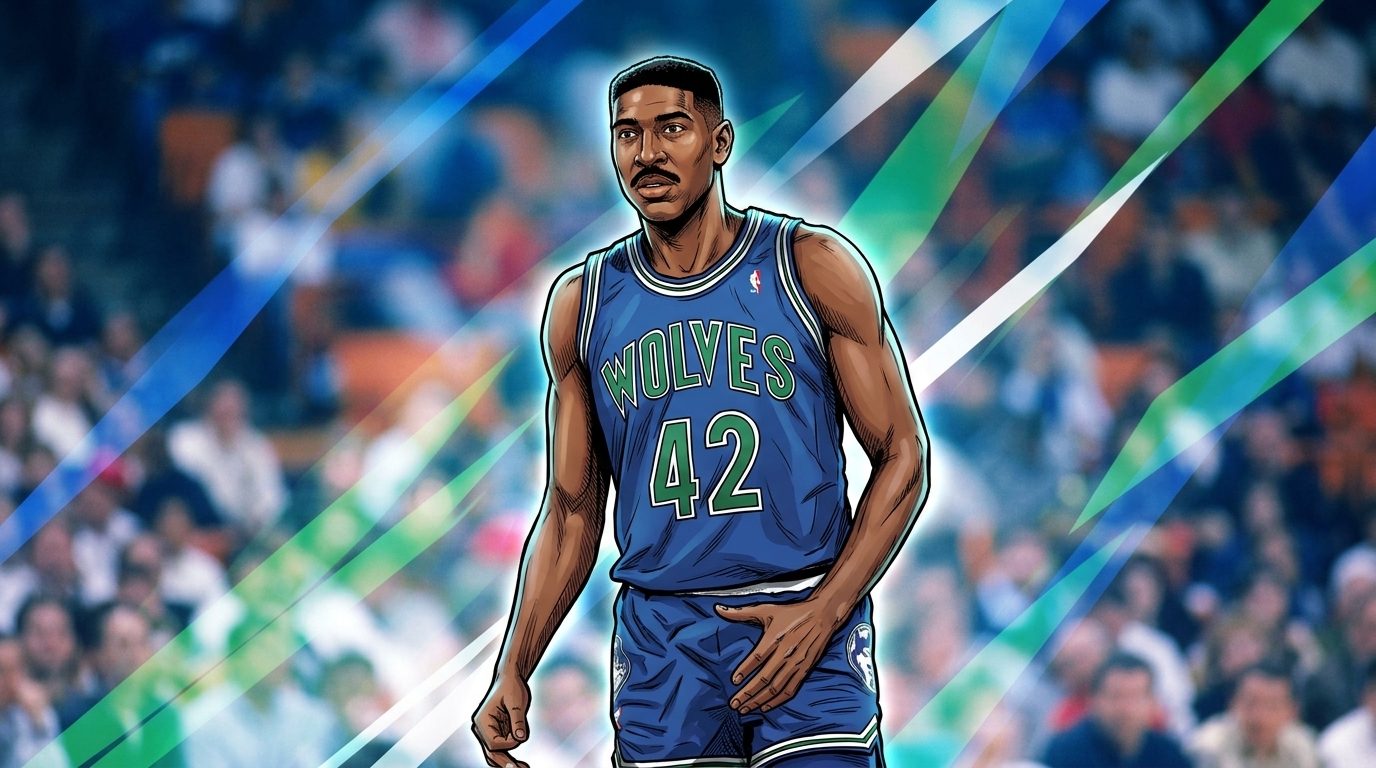
Sam Mitchell is the connective tissue of the Timberwolves’ first quarter-century: an original 1989 Wolf, Kevin Garnett’s mentor, later the interim head coach, and the second-most-tenured player in franchise history.
| Vitals | |
|---|---|
| Born | September 2, 1963, Columbus, Georgia |
| High school | Columbus (Columbus, Georgia) |
| College | Mercer |
| Drafted | No. 54 overall, 1985 (Houston) |
| Seasons as a Wolf | 10 (1989–1992, 1995–2002) |
| Number | 42, later 5 |
A career in three acts. Few names are woven as deeply into the Minnesota Timberwolves as Sam Mitchell’s. He was there for the very first tip-off in 1989, a 26-year-old rookie on an expansion roster nobody expected to win; he was there for the arrival of the teenager who would change everything, hand-picked to teach Kevin Garnett how to be a professional; and he came back a third time in a suit, taking the interim head-coaching job under the worst circumstances the franchise has known. Over 13 NBA seasons he played 994 games and scored 8,636 points, but the number that tells the story is 757 — his games as a Wolf, second only to Garnett in franchise history.
The long road to the NBA. Mitchell did not arrive by the usual door. A 6-foot-6 forward and the leading scorer in Mercer University history, he was a third-round pick of the Houston Rockets in 1985 and got cut before the season started. What followed was the kind of grind that makes a career worth telling: three years in the Continental Basketball Association, a championship with the Rapid City Thrillers in 1987, and a stint overseas with Montpellier in France. He was already 26, older than most players reporting to their first NBA training camp, when the newly minted Minnesota Timberwolves gave him a roster spot in 1989.
An original Timberwolf. He made the most of it. On a raw expansion team learning how to lose gracefully, Mitchell was a bright spot from the start, averaging 12.7 points and 5.8 rebounds across 80 games as a 26-year-old rookie and bumping that to 14.6 a night the following year. He was durable, physical, and reliable, the sort of veteran-minded pro an expansion franchise needs to set a standard. After three seasons he was traded to the Indiana Pacers, where he spent three more and reached the Eastern Conference Finals in 1995. Minnesota, though, was not done with him.
The Garnett years. In the summer of 1995 the Timberwolves drafted a 19-year-old out of Chicago’s Farragut Academy with the No. 5 overall pick and, that same offseason, brought Mitchell home. The pairing was no accident. General manager Kevin McHale asked the veteran to take the raw, wildly gifted teenager under his wing, and Mitchell did exactly that, becoming Garnett’s first and most influential mentor at the moment the future MVP most needed one. The two grew close enough to be described as family, and the results spoke for themselves: Garnett blossomed into the cornerstone of the franchise while Mitchell settled into the role of steady elder statesman, a locker-room compass through Minnesota’s first sustained run of relevance. He played seven seasons alongside Garnett before retiring after the 2001-02 campaign. He left as the franchise’s iron man, ranking second in games played and fifth in scoring in team history.
The coach. Retirement only changed his uniform. Mitchell joined the Milwaukee Bucks as an assistant in 2002 and, two years later, was named the sixth head coach in Toronto Raptors history. His crowning moment came in 2006-07, when he guided Toronto to a 47-35 record, the first division title in that franchise’s history, and was voted NBA Coach of the Year. He coached the Raptors until December 2008 and finished his head-coaching résumé at 185-242. Then, once more, Minnesota called. Mitchell rejoined the Wolves as an assistant in 2014 and was thrust into the interim head job in September 2015 after Flip Saunders stepped away following his diagnosis with Hodgkin’s lymphoma. When Saunders died that October, it fell to Mitchell to steer a grieving organization and its brilliant young core through a 29-53 season, an assignment no one would have wished for and one he accepted without flinching.
By the numbers
Regular-season stats with the Wolves, per Basketball-Reference:
| Season | GP | PPG | RPG |
|---|---|---|---|
| 1989-90 | 80 | 12.7 | 5.8 |
| 1990-91 | 82 | 14.6 | 6.3 |
| 1991-92 | 82 | 10.1 | 5.8 |
| 1995-96 | 78 | 10.8 | 4.3 |
| 1996-97 | 82 | 9.3 | 4.0 |
| 1997-98 | 81 | 12.3 | 4.8 |
| 1998-99 | 50 | 11.2 | 3.6 |
| 1999-00 | 66 | 6.5 | 2.1 |
| 2000-01 | 82 | 3.5 | 1.5 |
| 2001-02 | 74 | 3.3 | 1.1 |
Wolves career totals
Ten-season totals via Basketball-Reference and StatMuse.
Franchise ranks
- 2nd Games played (757)
- 3rd Minutes played (18,394)
- 5th Points (7,161)
- 5th Field goals made (2,664)
- 6th Rebounds (3,030)
Per the all-time franchise leaderboard.
Accolades
- NBA Coach of the Year, 2006-07 (Toronto)
- Member of the inaugural 1989-90 Timberwolves
- CBA champion, 1987 (Rapid City Thrillers)
- Led Toronto to its first division title, 2006-07
Lore
The pro who came up the hard way. Long before the mentor role, Mitchell was living proof that the NBA door can open late for a player stubborn enough to keep knocking. Getting cut by Houston, riding CBA buses to Rapid City, chasing a paycheck to France, and then breaking in as a rookie at 26 gave him a perspective most first-round darlings never earn. That perspective is exactly why the Timberwolves trusted him with the most important teenager they would ever draft.
Garnett’s first teacher. Ask about the making of Kevin Garnett and Sam Mitchell’s name comes up before almost any other. The franchise paired the 32-year-old veteran with the 19-year-old phenom on purpose, and Mitchell delivered the toughness, the professionalism, and the daily habits that would carry Garnett to an MVP and a Hall of Fame career. When people say KG grew up in Minnesota, they mean in part that he grew up next to Sam Mitchell.
The uniform never mattered, only the loyalty. Player, mentor, assistant, interim head coach through the darkest week in team history — no one has answered the Timberwolves’ call in as many forms as Mitchell. He is the connective tissue between the expansion era and the modern one, a man whose fingerprints are on the franchise’s first game, its first true star, and its most difficult season. In a history full of stars who left to win elsewhere, Sam Mitchell is the rare figure who kept coming back.
The Wolves have employed bigger stars. None has stood at as many of the franchise’s turning points.