Sam Cassell
The point guard of the best regular-season team in Timberwolves history, whose 2004 playoff hip injury became the franchise's greatest what-if.
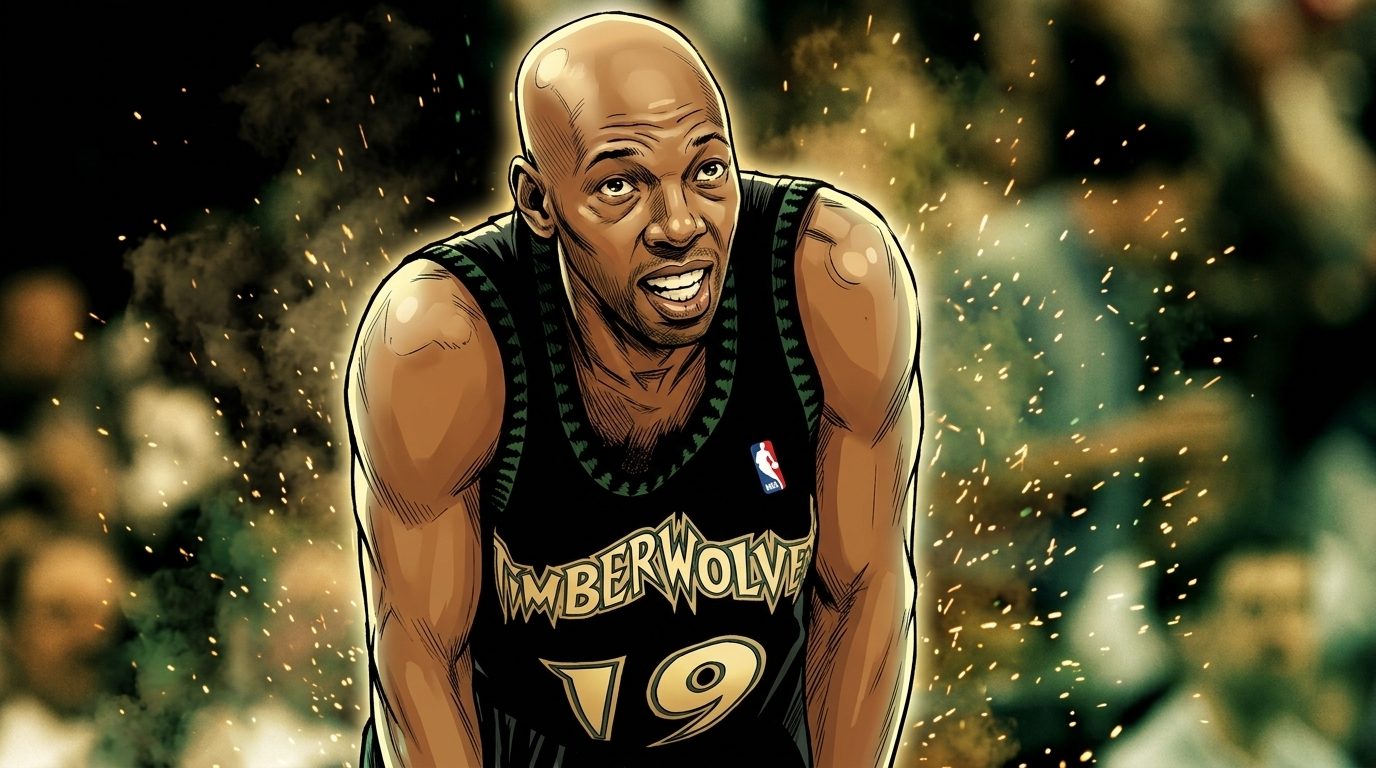
The Timberwolves have never had a regular season like 2003-04, and never a point guard quite like the one who ran it.
| Vitals | |
|---|---|
| Born | November 18, 1969, Baltimore, Maryland |
| High school | Dunbar (Baltimore) |
| College | Florida State (two seasons) |
| Drafted | No. 24 overall, 1993 |
| Seasons as a Wolf | 2 (2003–2005) |
| Number | 19 |
The missing piece. For two seasons the Minnesota Timberwolves employed exactly the point guard they had spent a decade searching for, and the team he steered to the West’s No. 1 seed is still the one fans point to as the franchise’s best shot at the NBA Finals. Sam Cassell was the steadying hand and the crunch-time nerve of the greatest regular-season team the Wolves have ever assembled. He was also, thanks to one corner jumper and the celebration that followed it, the author of the most painful what-if in franchise history.
The arrival. Cassell came to Minnesota in the summer of 2003, shipped in from Milwaukee alongside Ervin Johnson in exchange for Joe Smith and Anthony Peeler, per Wikipedia. He was 33, a two-time champion from his Houston years, and already carrying a reputation as a gunner who talked more than his teams liked. The Wolves did not care about any of that. For years they had asked Kevin Garnett to be the best player on the floor and the primary shot creator at once, and it had cost them seven straight first-round exits. Cassell, paired that same offseason with Latrell Sprewell, was the answer to the first problem. He gave Garnett a genuine second star and a floor general who wanted the ball with the clock running down.
The season. What followed was the finest year in club history. The 2003-04 Timberwolves went 58-24, the No. 1 seed in the Western Conference and still the winningest regular season the franchise has ever posted. Garnett won MVP. Cassell, at an age when most guards are managing decline, produced the best all-around season of his life: 19.8 points and 7.3 assists a night on 48.8 percent shooting, a career-high 39.8 percent from three, the first and only All-Star selection of his 15 NBA seasons, and an All-NBA Second Team nod. On a team defined by Garnett’s relentlessness and Sprewell’s edge, Cassell supplied the swagger and the late-game answers, and he punctuated the biggest of them with a celebration the whole league already knew.
The injury. Then came the playoffs, and the run that should have ended in the Finals. Cassell opened the postseason with a pair of 40-point outbursts, 40 against Denver in the opener and 40 more to open the Sacramento series. Minnesota beat the Nuggets in five and outlasted the Kings in a seven-game classic to reach the Western Conference Finals for the first time. Somewhere in that grind his hip gave out. The most widely told version of the story, endorsed by coach Flip Saunders, holds that the avulsion fracture traced back to a corner jumper and the emphatic dance that celebrated it. Against the Lakers he was a ghost of himself, logging one minute in Game 2 and five in Game 4, unable to give Garnett the running mate the moment demanded. Minnesota fell in six. Shaquille O’Neal, Kobe Bryant, Gary Payton and Karl Malone were a formidable wall regardless, but a healthy Cassell is the hinge on which every retelling turns, and that six-game loss is the near-miss the franchise has never stopped relitigating.
The unraveling. The magic did not survive the summer. Injuries limited Cassell to 59 games in 2004-05. His production slid to 13.5 points and 5.1 assists. The locker room that had felt bulletproof a year earlier came apart. Cassell was openly unhappy about not being offered a contract extension, the front office grew weary of the friction, and a 44-38 team that had been to the conference finals a year before missed the playoffs entirely. That August, Minnesota traded him and a conditional first-round pick to the Los Angeles Clippers for Marko Jarić and Lionel Chalmers. The promising partnership that had produced the best basketball in franchise history lasted exactly two years, and the second one undid much of what the first had built.
By the numbers
Regular-season stats with the Wolves, per Basketball-Reference:
| Season | GP | PPG | RPG | APG | FG% | 3P% |
|---|---|---|---|---|---|---|
| 2003-04 | 81 | 19.8 | 3.3 | 7.3 | .488 | .398 |
| 2004-05 | 59 | 13.5 | 2.7 | 5.1 | .464 | .262 |
Wolves career totals
Two-season totals via StatMuse.
Franchise ranks
- 5th Player efficiency rating (21.4)
- 5th Assist percentage (37.0)
- 8th Assists per game (6.4)
Per the all-time franchise leaderboard.
Accolades
- 2004 NBA All-Star (his only selection)
- All-NBA Second Team, 2004
- Franchise-record 58-win season, 2003-04
- 3× NBA champion (1994, 1995, 2008 — none in Minnesota)
Lore
The Big Balls dance. No single gesture is more bound up with the 2003-04 season than the celebration Cassell brought with him. After a big shot he would hunch, bow his legs and shuffle up the floor as though hauling an anatomically improbable burden between them, a bit he lifted years earlier from the baseball comedy Major League II. It was crude, it was hilarious, and it made him one of the most quotable characters the franchise has ever housed. The NBA did not share the amusement. As Cassell has told it, David Stern warned him a repeat would cost $25,000, and the league eventually outlawed the move outright, which of course turned the ban into the best press the dance ever got. That it may also have literally broken his hip only made the lore heavier.
Sam I Am. Cassell was a personality first and a stat line second, which is precisely why Minnesota adored him. He guaranteed wins, narrated his own greatness, and backed enough of it up to be forgiven the rest. The nickname “Sam I Am” followed him from city to city, and in his one healthy Timberwolves season it fit a player who genuinely was the difference between another first-round flameout and a conference finals berth. Twenty years on, fans who lived through it still describe the 2003-04 group with a reverence usually reserved for the Garnett-Cassell-Sprewell core alone.
The great what-if. Franchise historians have relitigated the 2004 hip a hundred times, and the debate never fully closes. A healthy Cassell does not guarantee a title against that Lakers team, and honesty requires saying so. But he was the best supporting piece Garnett ever had in Minnesota, arriving in the one spring the Wolves owned the West’s top seed. His absence at the decisive moment is why so many treat that season as the one that got away. The Timberwolves would not win another playoff series until 2024. For a franchise conditioned to expect the floor to fall out from under it, Sam Cassell’s hip is the original trap door.
For two seasons he was the answer, and he has been the question ever since.