Ricky Rubio
The beloved Spanish playmaker who arrived in 2011 and left as the most gifted passer the franchise had seen since Garnett. Second all-time in Wolves assists and steals.
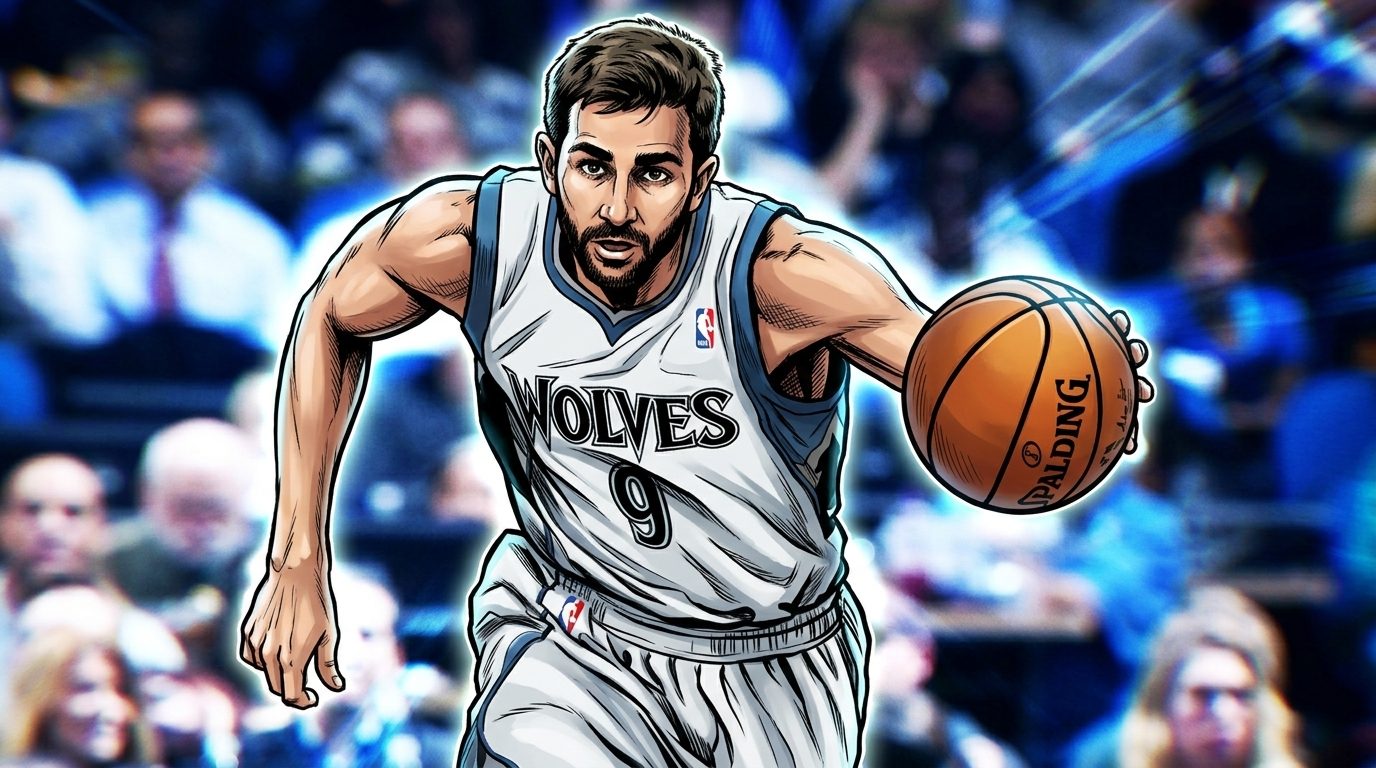
Ricky Rubio was a one-of-a-kind a passer, throwing the ball to places his teammates had not yet imagined. He turned middling rosters into must-watch basketball and captured the heart of the Minnesota fanbase in the process.
| Vitals | |
|---|---|
| Born | October 21, 1990, El Masnou, Catalonia, Spain |
| Pre-NBA | DKV Joventut and FC Barcelona (Spain), 2005–2011 |
| Drafted | No. 5 overall, 2009 |
| Seasons as a Wolf | 7 (2011–2017, 2020–2021) |
| Number | 9 |
The arrival. Minnesota drafted Ricky Rubio fifth overall in 2009, then waited two full years while he honed his craft in Spain, the pick treated locally like a lottery ticket nobody was sure would ever pay out. When he finally landed in the fall of 2011, the wait made sense inside a week. Here was a 21-year-old who saw passing lanes that hadn’t opened yet, who threw the ball to spots on the floor before his teammates knew to run to them. A franchise that had spent years being dutiful and dull suddenly had a player worth the price of the ticket. He made the 2011-12 All-Rookie First Team despite playing only 41 games, and the reason he stopped at 41 is the second chapter of his story.
The knee. On March 9, 2012, with the Timberwolves genuinely in a playoff race for once, Rubio’s left leg buckled underneath him after a collision with Kobe Bryant. The diagnosis was a torn ACL and LCL, and the season that had felt like a turning point simply ended. Grantland’s requiem carried the title “The Death of Ricky Rubio,” which was hyperbole about the player and painfully accurate about the moment. Minnesota’s momentum went with the knee. He came back the following December, but the explosive burst that had made the injury possible never fully returned.
The artist on a losing team. What Rubio became instead was one of the most productive playmakers in franchise history while the wins refused to come. He led the team in assists year after year, ran the fast break like a conductor, and was, by most accounts, the roster’s best perimeter defender, his hands quick enough to turn a careless entry pass into a layup at the other end. His best season came in 2016-17: 11.1 points, a career-high 9.1 assists, and a career-best .402 from the field, per Basketball-Reference. The jumper was always the tax on the whole package, and opponents dared him to shoot it for a decade. It never stopped him from being worth watching.
The grief and the grace. In the middle of all of it came the hardest year. Rubio’s mother, Tona Vives, died of lung cancer in May 2016 at age 56, after a four-year fight he had carried quietly through NBA seasons. He launched the Ricky Rubio Foundation in her memory to fund cancer research, and he played the following winter, his finest as a Wolf, with a weight on him that the box score never showed. Minnesota loved him for the passing. It loved him more for how he carried that.
The two goodbyes. With Tom Thibodeau reshaping the roster around Karl-Anthony Towns and Andrew Wiggins, Minnesota traded Rubio to Utah in June 2017 for a protected first-round pick. The parting stung, because Wolves fans understood exactly what they were losing. He came back once more, in a three-team deal in November 2020, and spent a steadying veteran season mentoring the young backcourt before being dealt to Cleveland in the summer of 2021. Two arrivals, two exits, and a permanent place in the affection of a fanbase that doesn’t hand it out lightly.
By the numbers
Regular-season stats as a Timberwolf, per Basketball-Reference:
| Season | GP | PPG | RPG | APG | SPG | FG% | 3P% |
|---|---|---|---|---|---|---|---|
| 2011-12 | 41 | 10.6 | 4.2 | 8.2 | 2.2 | .357 | .340 |
| 2012-13 | 57 | 10.7 | 4.0 | 7.3 | 2.4 | .360 | .293 |
| 2013-14 | 82 | 9.5 | 4.2 | 8.6 | 2.3 | .381 | .331 |
| 2014-15 | 22 | 10.3 | 5.7 | 8.8 | 1.7 | .356 | .255 |
| 2015-16 | 76 | 10.1 | 4.3 | 8.7 | 2.1 | .374 | .326 |
| 2016-17 | 75 | 11.1 | 4.1 | 9.1 | 1.7 | .402 | .306 |
| 2020-21 | 68 | 8.6 | 3.3 | 6.4 | 1.4 | .388 | .308 |
Wolves career totals
421Games 4,235Points 1,721Rebounds 3,424Assists 845Steals
Franchise ranks- 2nd Assists (3,424, behind Kevin Garnett)
- 2nd Steals (845, behind Kevin Garnett)
Per the all-time franchise leaderboard.
Accolades- NBA All-Rookie First Team, 2012
- 2019 FIBA World Cup MVP and champion (Spain)
- Olympic silver, Beijing 2008
- Olympic bronze, Rio 2016
Lore
The night it turned. The knee injury against the Lakers is the great what-if of the post-Garnett rebuild. Minnesota was 21-20 and, for the first time in years, playing games that mattered in March. Rubio went down, the season came apart, and the franchise’s playoff drought — already the longest in the league — stretched on. Fans still replay the collision the way you poke a bruise to see if it still hurts. It does.
Rubio to Love. For two seasons the most reliable highlight in Minnesota was Rubio flinging an outlet pass the length of the floor and Kevin Love catching it in stride. The two of them turned a bad team into appointment viewing on League Pass, a duo built entirely on a passer who trusted his big man to be exactly where the ball was going. When Love was later traded, the connection became one of the great unfinished sentences of the era.
For Tona. Rubio’s Ricky Rubio Foundation, founded after his mother’s death in 2016, folded private grief into something lasting. He wore the loss openly, spoke about it plainly, and gave the most productive basketball of his life the same winter. Wolves fans who lived through it never separated the player from the person again.
The playoffs he never saw. In seven seasons across two stints, Ricky Rubio never played a single postseason game for Minnesota. The Timberwolves finally broke the drought in 2018, the spring after they traded him to Utah, and Rubio watched from another uniform. It is the cruelest footnote in his file: the player who did more than anyone to make Minnesota watchable in the lean years was gone the moment the good years arrived.
The homecoming. His 2020-21 return was quieter than the first act — a 30-year-old veteran steering a rebuilding roster and passing along everything he knew to a young Anthony Edwards. It lasted one season before the trade to Cleveland, but it gave the fanbase a chance to say a proper goodbye it hadn’t gotten in 2017.
The wins were rare and the jumper was a rumor, but nobody who watched the Timberwolves in those years forgets how it felt to see Ricky Rubio throw a pass.