Kevin Love
Kevin Love gave Minnesota six seasons of historic numbers — a 30-30 game, a 53-game double-double streak, three All-Star nods — yet not one playoff game.
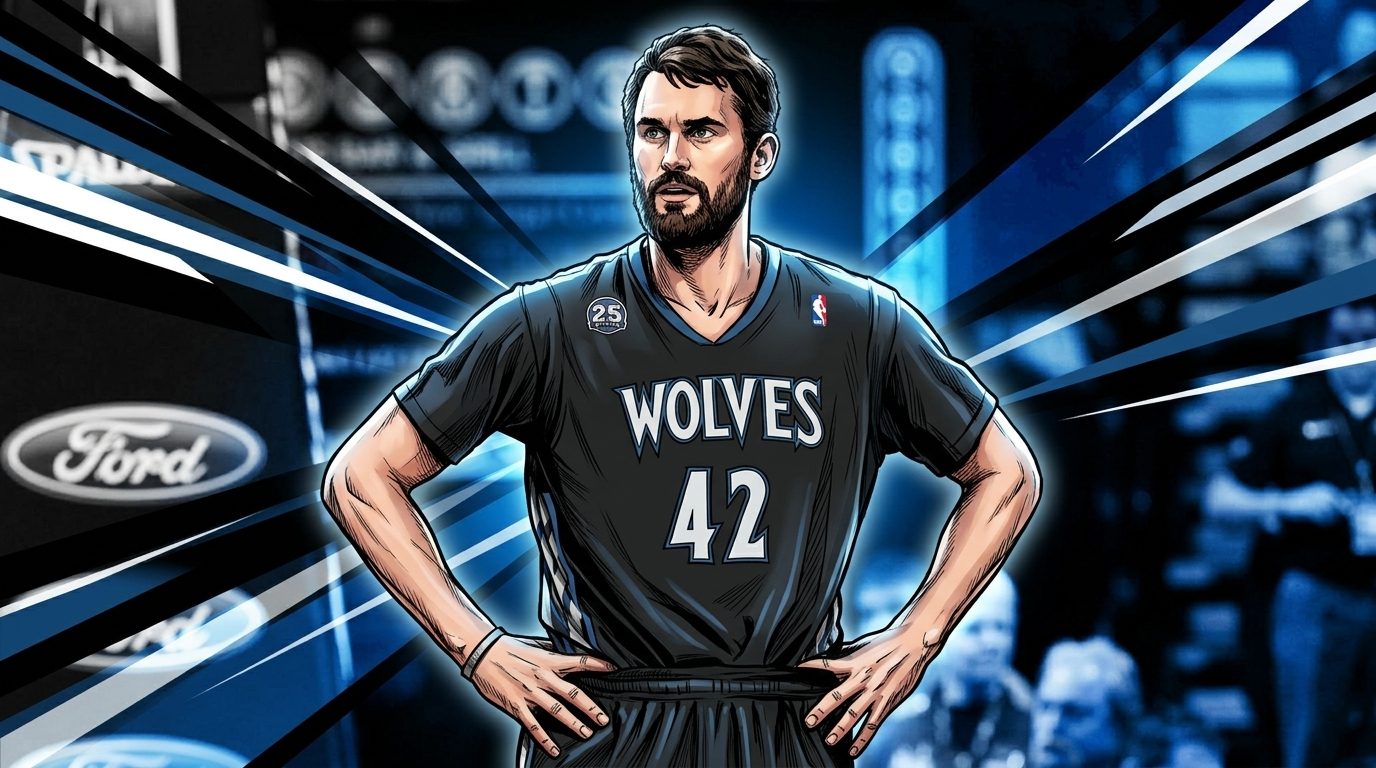
For six seasons between Kevin Garnett and Anthony Edwards, Kevin Love was the best reason to watch a team that never got him to the postseason.
| Vitals | |
|---|---|
| Born | Sept. 7, 1988, in Santa Monica, California |
| Position | Power Forward / Center |
| Number | 42 |
| College | UCLA (one season) |
| Drafted | 5th overall, 2008 (by Memphis; traded to Minnesota) |
Acquired before he ever unpacked. Love was never actually drafted by the Timberwolves. Memphis took the UCLA freshman fifth overall in the 2008 draft and shipped his rights to Minnesota in an eight-player blockbuster built around O.J. Mayo. General manager Kevin McHale wanted the big man and engineered the trade to get him, a rare instance of Minnesota reading the board correctly. The rookie averaged a modest 11.1 points and 9.1 rebounds, but the outlet passes and the nose for the ball were already there. The rest was a matter of the body catching up to the instincts.
The historic leap. It caught up fast. In 2010-11 Love jumped to 20.2 points and a league-leading 15.2 rebounds a game, becoming the first player to average at least 20 and 15 since Moses Malone in 1982-83 and running away with the Most Improved Player award. On Nov. 12, 2010 he dragged the Wolves back from a 21-point hole to beat the Knicks with 31 points and 31 rebounds, the NBA’s first 30-30 game in nearly three decades and a single-game franchise rebounding record. That same winter he began a run of consecutive double-doubles that reached 53 before it ended in Golden State in March 2011, the longest such streak since Elvin Hayes ran off 55 in 1973-74. He was 22 years old, playing for a team that would win 17 games. The individual brilliance and the collective misery arrived together, and they never really separated.
Peak, and the prototype. The next two healthy seasons only widened the gap between the player and the losing team around him. Love made his first All-Star team in 2011. He added a second nod and a spot on the All-NBA Second Team in 2011-12 while averaging 26.0 points and 13.3 rebounds, then won the 2012 Three-Point Contest at All-Star Weekend, outlasting Kevin Durant in the final. A power forward who could bang the glass, throw a full-court outlet, and stroke it from range was exactly the modern archetype the league was about to fall in love with. Minnesota had the prototype early. It could not get him to a winning record.
The contract, then the lost winter. In January 2012 the front office reached the fork that would define everything after it. Love wanted the five-year maximum “designated player” extension; ownership offered four years with an early opt-out, and he signed it. “I was willing to make a commitment for five years. They thought otherwise,” Love said at the time. The shorter deal set an exit clock, putting Love on track for unrestricted free agency by 2015; owner Glen Taylor later admitted he would have offered the fifth year if he could do it again. Then came the most Minnesota chapter of all: before the 2012-13 season, Love broke the third and fourth metacarpals in his shooting hand doing knuckle pushups in his condo. He returned, reinjured the hand, and played only 18 games in a season that buried any playoff hope.
The last great year, and the exit. Love answered with the best all-around season of his Minnesota tenure in 2013-14: 26.1 points, 12.5 rebounds, and a career-high 4.4 assists a game, another All-NBA Second Team, and a passing game that turned him into a genuine offensive hub. The Wolves went 40-42 and missed the playoffs anyway, extending a streak that would define his Minnesota tenure: not one postseason game, ever. With free agency looming and no fifth year to lean on, the front office read the room and moved him. On Aug. 23, 2014, Minnesota sent Love to Cleveland at the center of a three-team deal for No. 1 overall pick Andrew Wiggins, former top pick Anthony Bennett, and Thaddeus Young. Love joined LeBron James and, in 2016, won the championship Minnesota never came close to in his six seasons.
By the numbers
Per Basketball-Reference, Love’s six Minnesota seasons:
| Season | G | PPG | RPG | APG | FG% | 3P% |
|---|---|---|---|---|---|---|
| 2008-09 | 81 | 11.1 | 9.1 | 1.0 | .459 | .105 |
| 2009-10 | 60 | 14.0 | 11.0 | 2.3 | .450 | .330 |
| 2010-11 | 73 | 20.2 | 15.2 | 2.5 | .470 | .417 |
| 2011-12 | 55 | 26.0 | 13.3 | 2.0 | .448 | .372 |
| 2012-13 | 18 | 18.3 | 14.0 | 2.3 | .352 | .217 |
| 2013-14 | 77 | 26.1 | 12.5 | 4.4 | .457 | .376 |
Wolves career totals
Franchise ranks
- 1st in rebounds per game (12.2)
- 3rd in total rebounds (4,453)
- 3rd in offensive rebounds (1,345)
- 6th in total points (6,989)
Per the all-time franchise leaderboard.
Accolades
- 3× NBA All-Star (2011, 2012, 2014)
- 2× All-NBA Second Team (2011-12, 2013-14)
- NBA Most Improved Player (2010-11)
- NBA rebounding champion (2010-11)
- Three-Point Contest champion (2012)
Lore
The knuckle pushups. The injury became a permanent punchline: a franchise player fracturing his shooting hand on a bodyweight exercise, then patiently repeating the story to a disbelieving press corps until everyone gave up and believed him. It cost him all but 18 games of a season the roster was finally supposed to be catching up in, the cruelest kind of Wolves luck.
The outlet pass. It turned into its own genre of highlight: Love ripping a rebound and firing a baseball throw the length of the floor before the defense had turned around, a skill so specific it felt borrowed from a different sport.
The 30-30 night. The Nov. 12, 2010 win over the Knicks still gets pulled up every November, a reminder that for one winter a 22-year-old in a 17-win season was quietly doing things the league hadn’t seen since 1982.
Numbers in a vacuum. The tragedy of it, the part Wolves fans learned to hold at arm’s length, is that the numbers were the whole story. There was never a playoff run to attach them to, only six lottery seasons and the highlights that outlived them.
The Wolves acquired him in a trade and lost him in one, and in between he was great for teams that never mattered in April.