Joe Smith
The No. 1 overall pick of 1995 whose secret Timberwolves contract triggered the harshest penalty in NBA history and gutted Kevin Garnett's prime.
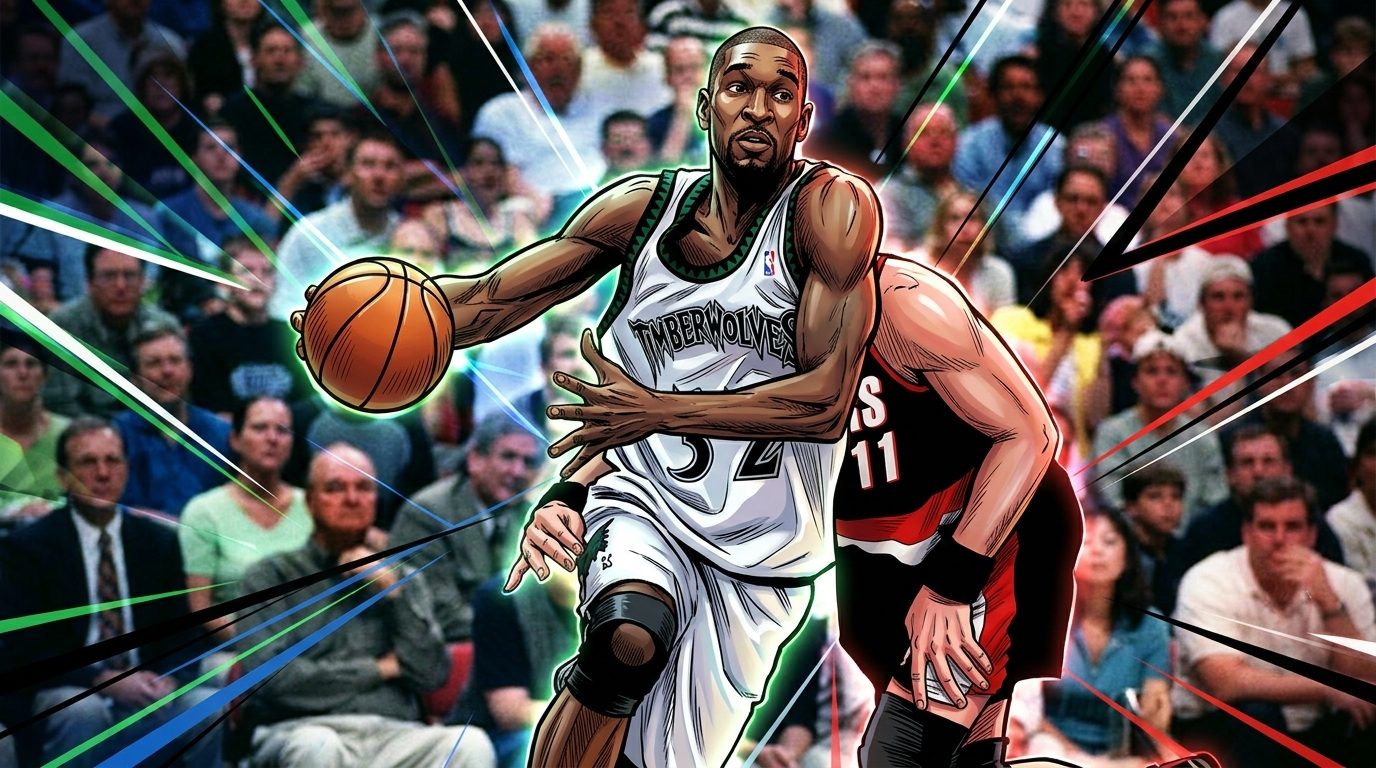
Joe Smith never averaged eleven points a game in a Timberwolves uniform, and no player in franchise history ever did more lasting damage — not on the floor, but in a drawer.
| Vitals | |
|---|---|
| Born | July 26, 1975, Norfolk, Virginia |
| High school | Maury (Norfolk, Virginia) |
| College | Maryland (two seasons) |
| Drafted | No. 1 overall, 1995 (Golden State) |
| Seasons as a Wolf | 4, across two stints (1998–2000, 2001–2003) |
| Number | 32 |
The signing. In the summer of 1998, with the roster capped out around a 22-year-old Kevin Garnett who had just signed the richest contract in league history, Minnesota added a former No. 1 overall pick for the price of a role player. Joe Smith took a one-year deal worth under $2 million, far beneath his market, and produced like a bargain: 13.7 points and 8.2 rebounds across 43 games in the lockout-shortened 1998-99 season, a springy, skilled complement to Garnett in the frontcourt. He re-upped the next summer on another cut-rate one-year contract. On the surface it looked like a team finding value and a player betting on himself. Underneath, the two sides had already agreed to something the league was never meant to see.
The paper trail. The bet was a secret side agreement: a run of below-market one-year deals, after which the Timberwolves would use the Bird rights Smith accumulated to hand him a long-term contract reported as high as $86 million over seven years. The arrangement circumvented the salary cap by hiding future money nobody had sanctioned. The NBA’s own audits missed it. The documents surfaced through a lawsuit: agent Eric Fleisher’s litigation with a former associate pulled them into discovery, and by the fall of 2000 the league had the paper in hand.
The hammer. In October 2000, commissioner David Stern delivered the most severe penalty ever levied against an NBA franchise. The league voided Smith’s contract, stripped the Bird rights the whole scheme existed to manufacture, and fined the Timberwolves $3.5 million. Then came the part that outlived everything else: it took five consecutive first-round draft picks (2001, 2002, 2003, 2004, 2005). Owner Glen Taylor was barred from team operations for roughly a year; general manager Kevin McHale was forced onto unpaid leave. Two of the picks, 2003 and 2005, were later returned, leaving a net loss of three first-rounders. For a small-market team trying to build cheap, young depth around a superstar in his prime, that was a wound to the foundation, not the paint.
The return. Voided in Minnesota, Smith spent 2000-01 in Detroit, and then came back. In August 2001 the Timberwolves re-signed him, this time entirely by the book, and he gave them two more steady seasons, including his best shooting mark as a Wolf, .511, in 2001-02. His second act ended with the move that mattered most: in June 2003, Minnesota packaged Smith and Anthony Peeler to Milwaukee for Sam Cassell and Ervin Johnson, the deal that finally handed Garnett a genuine co-star. The 2003-04 team won 58 games, Garnett won MVP, and Minnesota reached the only Western Conference Finals of his tenure. The player whose contract had cost the franchise its draft became the chip that briefly bought it contention.
By the numbers
Regular-season stats, per Basketball-Reference:
| Season | GP | PPG | RPG | APG | FG% | 3P% |
|---|---|---|---|---|---|---|
| 1998-99 | 43 | 13.7 | 8.2 | 1.6 | .427 | .000 |
| 1999-00 | 78 | 9.9 | 6.2 | 1.1 | .464 | 1.000 |
| 2001-02 | 72 | 10.7 | 6.3 | 1.1 | .511 | .667 |
| 2002-03 | 54 | 7.5 | 5.0 | 0.7 | .460 | .000 |
Wolves career totals
Franchise ranks
- 9th Offensive rebounds (603)
Per the all-time franchise leaderboard.
Accolades
- No. 1 overall pick, 1995 NBA Draft
- NBA All-Rookie First Team, 1996
- Consensus first-team All-American (Maryland), 1995
Lore
The number was five. Every retelling of the scandal turns on one figure: five straight first-round picks, gone in a single ruling. Even with two later restored, the Timberwolves spent the heart of Garnett’s prime unable to draft the cheap young talent that keeps a contender’s window open. The team that could least afford to lose bites at the apple lost three of them at once, and the franchise’s long slide toward Garnett’s 2007 exit began, in part, in that drawer.
The bargain that wasn’t. The whole plot rested on a friendly logic: pay Smith light now, make him whole later. And it was precisely the friendliness that doomed it. A handshake worth tens of millions eventually needs to be written down, and once it was, it became the exact evidence a salary-cap system is built to punish. Minnesota did not get caught overspending. It got caught promising to.
The Cassell irony. The cruelest twist in the whole affair is that Smith’s exit produced the franchise’s high point. Trading him and Peeler for Sam Cassell reshaped the 2003-04 team into a 58-win juggernaut and Garnett into an MVP. For one spring, the man at the center of the scandal that cost Minnesota its future was also the reason it had one.
The nomad. Smith’s career after Minnesota became a traveling act — a big man who suited up for a dozen NBA franchises across 16 seasons before he was done. The No. 1 pick who was supposed to anchor a team spent his career belonging to almost all of them.
The wreckage, in one line.
The Timberwolves have made worse trades and drafted worse players, but they have never signed a costlier contract than the one they were never supposed to write down.