Isaiah Rider
The most electrifying talent of Minnesota's pre-Garnett years: a 1994 Slam Dunk Contest champion whose immense promise was swallowed whole by off-court chaos.
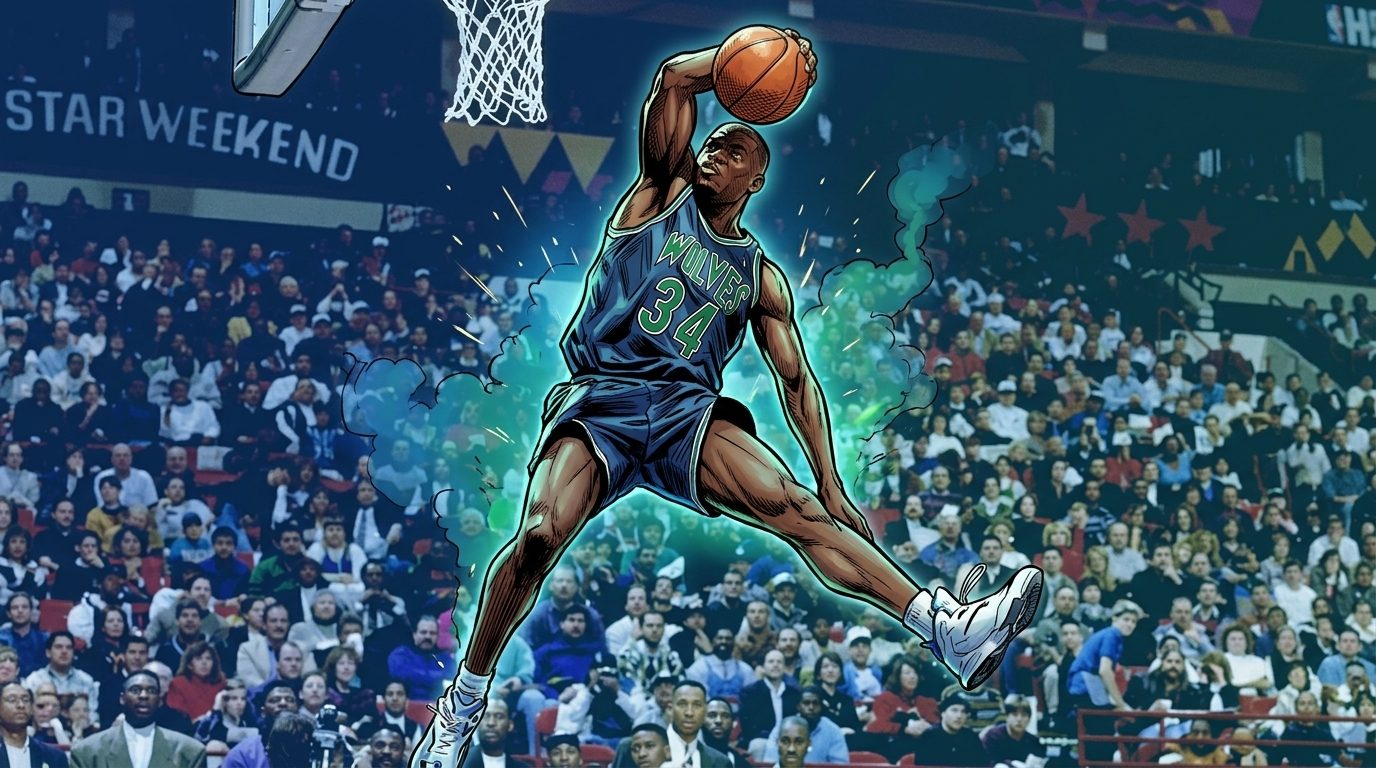
Before the franchise had a savior, it had a comet, and for three seasons the whole city stood in the yard, watching it burn a streak across a sky that never quite caught fire.
| Vitals | |
|---|---|
| Born | March 12, 1971, Oakland, California |
| High school | Encinal (Alameda, California) |
| College | Allen County CC, Antelope Valley College, UNLV |
| Drafted | No. 5 overall, 1993 |
| Seasons as a Wolf | 3 (1993–1996) |
| Number | 34 (also 7) |
The arrival. The Timberwolves took Isaiah Rider fifth overall in the 1993 draft, a bruising, bullish wing out of UNLV who had already worn out three colleges and arrived with a warning label. He also arrived with one of the most complete offensive games the young franchise had ever employed. He could rise over anyone, bury the three, and get to the rim through contact, and he backed it up immediately: 16.6 points per game as a rookie and a spot on the NBA All-Rookie First Team, per Basketball-Reference. In a building that had spent its infancy searching for a reason to buy a ticket, Rider was the reason.
The ascent. By his second season he was the team’s leading man, pouring in 20.4 points a night in 1994-95 and following it with 19.6 in 1995-96. He was a walking bucket on a team that could not stop anyone, a green light attached to a body built like a strong safety. Across his three Minnesota seasons he averaged 18.8 points, still eighth-best in franchise history three decades later, a mark set on rosters that never sniffed .500. The talent was never the question. Everything around it was.
The burden. Rider’s Minnesota tenure became a case study in how much a promising franchise can carry before it decides the load is not worth it. There were feuds with the front office and the coaching staff, a habit of missing flights and practices, and a mounting stack of legal trouble that turned a rising star into a nightly headache. The Wolves kept betting the talent would win out. It never did. In the summer of 1995 they used the fifth pick again, this time on a teenager named Kevin Garnett, and quietly began building around a temperament that was the opposite of the one they already had.
By the numbers
Regular-season stats, per Basketball-Reference:
| Season | GP | PPG | RPG | APG | FG% | 3P% |
|---|---|---|---|---|---|---|
| 1993-94 | 79 | 16.6 | 4.0 | 2.6 | .468 | .360 |
| 1994-95 | 75 | 20.4 | 3.3 | 3.3 | .447 | .351 |
| 1995-96 | 75 | 19.6 | 4.1 | 2.8 | .464 | .371 |
Wolves career totals
Franchise ranks
- 8th Points per game (18.8)
Per the all-time franchise leaderboard.
Accolades
- 1994 NBA Slam Dunk Contest champion
- NBA All-Rookie First Team, 1994
- Led the Timberwolves in scoring, 1994-95 and 1995-96
Lore
The East Bay Funk Dunk. On All-Star Saturday, February 12, 1994, the whole weekend came to Target Center, and the hometown rookie stole it. Rider ended the Slam Dunk Contest by cradling the ball, swinging it clean between his legs in midair, and hammering it home, a move he’d carried out of Oakland and christened the East Bay Funk Dunk. It drew a near-perfect 49 out of 50 and beat a field that included Shawn Kemp. For a franchise starved of national moments, it remains one of the loudest nights the building ever hosted, and the dunk still lives in every highlight reel.
He called his shot. The bravado was there from the start. Rider had told anyone who would listen, going back to draft night, that he intended to win the dunk title, and then he walked into his own arena and did exactly that. It was the purest version of the player the Wolves fell for: supremely gifted, utterly unbothered, and impossible to look away from.
The chaos that followed. The same fearlessness that made the highlights curdled everywhere else. Rider tangled repeatedly with management and coaches, and off the floor the incidents piled up: a fifth-degree assault conviction for kicking a sports-bar manager, and, in the weeks around his exit, an arrest on marijuana and illegal-cell-phone charges followed by a public-gambling arrest back in Oakland. Sports Illustrated later summed up the whole ride in a feature titled “Rider on a Storm.” The talent kept showing up; so did everything else.
The exit, and the pivot. On July 23, 1996, Minnesota shipped Rider to the Portland Trail Blazers for James Robinson, Bill Curley, and a conditional first-round pick, per UPI. The return was modest by design; the front office was cutting bait and clearing the runway. The player they’d drafted the summer before, Kevin Garnett, was about to make everyone forget the franchise had ever hitched its wagon to anyone else. Rider and Garnett shared one season as teammates in 1995-96, the old face of the team and the future one passing in the same locker room.
What might have been. Rider bounced through Portland, Atlanta, and a title-year cameo in Los Angeles before flaming out of the league entirely, his career finished before he turned 30. In Minnesota he is the great cautionary tale that precedes the great turnaround: the immensely talented wing who could have been a cornerstone and instead became the thing the Garnett era was built to replace.
Every franchise needs a before picture. This is Minnesota’s, dunking between its legs while the building comes apart.